
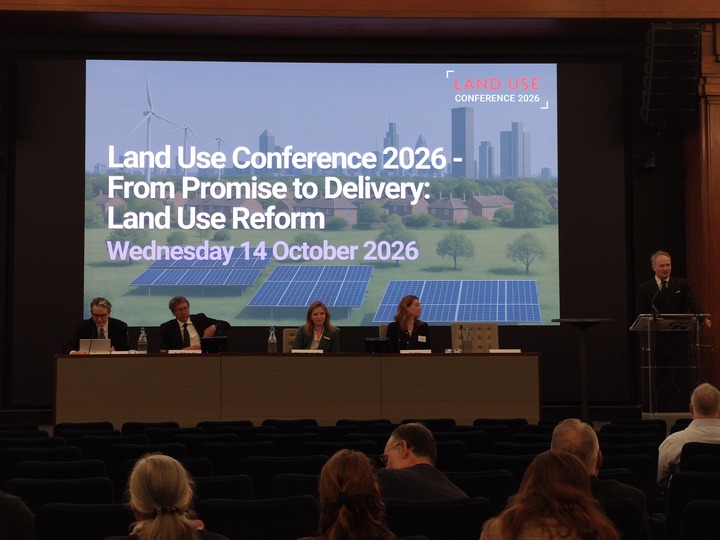
Event Report: Landmark Chambers’ Land Use Conference 2026
Our Associate Director, Aaron Henecke recently attended Landmark Chambers’ annual Land Use Conference, which brought together cross-sector expertise in planning, property and environmental law to discuss the most pressing issues facing the built environment sector. Aaron provides his thoughts below…
When I last attended the Land Use Conference in 2022 the political and planning landscape in the UK was vastly different to today. Then, we were 30 days into Liz Truss’ short-lived stint as Prime Minister, grappling with her pledge to scrap all remaining EU laws by the end of 2023, and trying to wrap our heads around emerging Biodiversity Net Gain requirements.
Whilst at first glance things might appear the same – another new PM, forthcoming changes to EIA and continued uncertainty over BNG – the Labour Government has enacted an ambitious programme of planning reforms that meant this year’s Conference took on a somewhat more optimistic tone. But as the details of Labour’s plans are becoming clearer, particularly with the publication of the new NPPF in August, there still remains uncertainty over the practical impacts of those reforms on housing delivery and development in the UK.
In her introductory speech, Alex Notay, CEO of The Housing Forum highlighted the positives of ‘impact investing’ for those involved with the built environment, stressing the importance of both ‘intentionality’ and ‘additionality’ when it comes to the success of those investments. Her message to the planning industry was clear: ‘Investors do not expect certainty of outcome, they expect certainty of process.’
Guy Williams KC and Melissa Murphy KC then got into the ‘nuts and bolts’ of the new NPPF, with a focus on the changes to the presumption in favour of sustainable development, both within and outside settlements. Though the intention behind those policy reforms is clear – i.e. to move towards a more rules-based planning system – Melissa was sceptical of whether that will play out in decision-making. She suggested that Housing Minister, Matthew Pennycook’s letter to the Planning Inspectorate on 6 October was meant to ‘galvanize’ Inspectors in that regard, a notion I would agree with. But the proof will be in the pudding.
Alex Goodman KC then examined the impacts of the Government’s reforms on public participation and local decision-making, including the National Scheme of Delegation due to take effect from 31st October (more on that to come). Alex summarised the reforms as an accumulation of changes intended to speed up and bring certainty to planning applications, albeit at the cost of local stakeholders.
On the climate front, Matthew Fraser and Claudia Hyde discussed the need to balance the interrelated issues of housing, biodiversity and climate change, noting the latest policies and legislation that grapple with climate resilience and BNG.
Throughout the day discussions kept coming back to the practical realities of delivery, in particular the current viability crisis facing much of the industry. Timothy Morshead KC considered the role land taxes play in helping or hindering growth, comparing various models and positing a hybrid alternative to land value taxation. No option ticks all the right boxes, but there certainly seems to be scope for a more equitable method for taxing land and property without deterring development.
Meanwhile, Reuben Taylor KC and Joel Semakula zeroed-in on CIL, Section 106 and viability. Reuben’s summary of the current state of play – housing permissions being at a 14-year low and delivery stalled across the country – was a sobering start to the session. He noted the drivers for this, including the significant rise in construction and finance costs and the delays caused by planning and the Building Safety Act. Reuben and Joel both provided advice on how to challenge the status quo of viability, advocating for participation by developers in the examination of CIL charging schedules and for renegotiating existing S106 agreements and land deals to reflect the current market.
Overall, the various speakers and attendees at this year’s Land Use Conference grappled admirably with significant issues facing the industry today, helping move the conversation forward just as Labour seeks to move the development sector forward. But if there was one message from the Conference for the Government to take away, it was this from George Mackenzie: ‘Stop tinkering with planning policy and let us get on with it’. Now, let’s see if they were listening…